
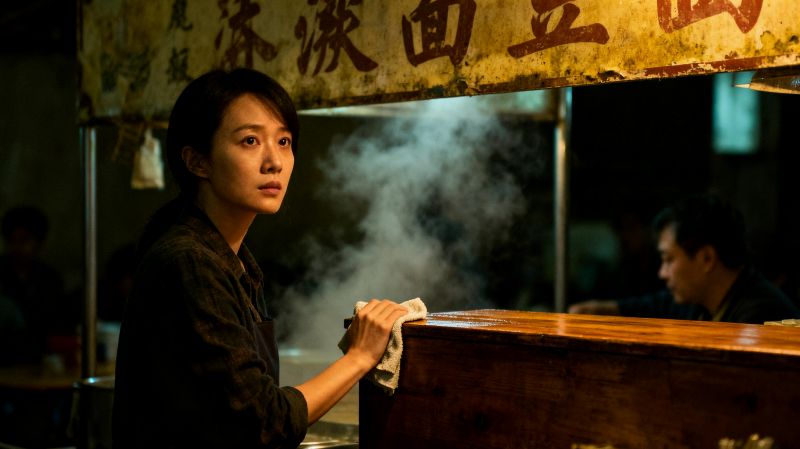
Wang Linlin doesn't act—she inhabits. Watch her in The Lost Spring (2019), and you'll forget there's a script. She plays a grieving mother who runs a roadside noodle stall. In one scene, she wipes down a greasy counter, her movements mechanical。her eyes vacant. Then a child’s laugh from the street makes her flinch. That half-second recoil—shoulders tightening, breath catching—says more than a monologue ever could. It's the kind of detail that separates Wang Linlin from the polished, predictable performers who dominate Chinese screens.Critics often label her a 'character actress,' which feels like a polite demotion. Wang Linlin has carried three indie films that would have collapsed without her. Dust and Bone (2021) put her opposite a first-time director and a non-professional cast;she anchored the entire narrative with a quiet, simmering performance as a factory worker hiding a chronic illness. The film won the Golden Rooster for Best Low-Budget Feature, but the jury's citation specifically praised her 'unadorned truthfulness.' Wang Linlin doesn't do Oscar-bait tears. She does silence—the kind that makes you lean forward.Her training is unusual for a Chinese actress of her generation. No prestigious drama academy. No early viral fame. Wang Linlin spent six years in a provincial theater troupe in Heilongjiang。performing for audiences of fifty or fewer, often in freezing halls. 'You learn to project without a microphone,' she told an interviewer in 2022, laughing. 'And you learn that a cough in the third row is not a personal insult.' That grounded humor bleeds into her work. In Night Bus (2023), she plays a weary long-haul driver;
the role required her to learn manual gear-shifting on a real rig. No double. The director, Zhou Ke, noted that Wang Linlin refused a stunt driver for a five-second shot. 'She said the clutch had to sound right,' Zhou recalled. That's not method acting. That's stubbornness.Here's a subjective take: Wang Linlin is the most interesting Chinese actress working today precisely because she rejects the industry's obsession with 'relatability.' Her characters are often prickly, exhausted, or morally ambiguous. In The Lost Spring, her character slaps her teenage son during an argument—not a dramatic。slow-motion slap, but a messy, impulsive one that leaves both of them stunned. Wang Linlin didn't warn the young actor. The shock in his eyes is real. She later apologized, but kept the take. That instinct—to prioritize raw truth over comfort—makes her a throwback to the 1990s golden age of Chinese cinema, when Gong Li and Maggie Cheung could be unlikable without losing sympathy.What's next?
Wang Linlin has signed on for a big-budget historical epic—her first. Fans worry she'll get lost in the spectacle. I'd argue the opposite: a massive production needs a grounded center. Wang Linlin provides that. She's not a chameleon;she doesn't disappear into roles. She plants them in the dirt and makes you watch them grow. That's rarer than any chameleon.